


**If you attended the 2026 Science Summit and have any feedback to provide, please visit the link here and fill out our feedback survey. Thank you!**
Date: January 21-22, 2026
Location: Leavenworth, WA
Theme: “Honoring the Past, Shaping the Future”
The Upper Columbia Salmon Recovery Board (UCSRB) is hosted the 2026 Upper Columbia Science Summit in Leavenworth, WA on January 21 and 22, 2026. This summit was an opportunity to forge and strengthen relationships through the exchange of information and discussion of key issues. The summit focused on adaptive management and was based on the theme of “Honoring the Past, Shaping the Future” to reflect our region’s acknowledgment of where we’ve come from and how to adapt our continuing efforts to support salmon recovery and benefit listed species. The summit was intended for a variety of active participants including monitoring and research professionals, project sponsors, contractors, regional technical team members, elected officials, agency representatives, academics, and the public.
Presentations Slides
Day 1: January 21st
Keynote Speaker: Davis “Yellowash” Washines, Yakama Nation, “The Collective Collaboration Continuum In Salmon Recovery Efforts Utilizing Modern Science and the Traditional Yakama Values of Wykanush-Mii-Wahkishwit (Spirit of the Salmon) to Achieve Success in the UCR Basin” (no slides)
Session: Status of the Species:
- Plenary: Katie Barnas, “Status of ESA listed Upper Columbia River spring Chinook salmon and steelhead”
- Tracy Bowerman, “Recent trends in Upper Columbia Bull Trout populations “
- John Crandall, “Status of Pacific Lamprey In the Upper Columbia”
Session: Species Survival and Life History
- Plenary: Scott Hinch, “Exceptionally high mortality of migrating adult female salmon: a large-scale pattern and a conservation concern”
- Plenary: Brian Burke, “Reading the Signals: Ocean Ecosystem Indicators, Recent Trends, and Why They Matter”
- Kevin See, “Correcting Bias in Spring Chinook Carcass Surveys – Impacts on Monitoring Metrics”
- Jeff Caisman, “Can’t beat em’? Make em’!: Genomic investigation reveals basis for trait selection of reintroduced Coho Salmon in the Wenatchee River Basin”
Session: Predation
- Plenary: Allen Evans, “Avian Predation on Upper Columbia River Salmon and Steelhead: A Review of Research, Monitoring, and Evaluation Studies”
- Ross Renick, “Sustaining No-Net Impact for Upper Columbia Salmon and Steelhead: Northern Pikeminnow Control at Chelan PUD Hydroelectric Projects”
Session: Collaborative Decision Making
- Plenary: Rene Henry, “Reorienting to Recovery: A Case Study in Values Informed, Landscape Scale, Collaborative Decision Making Towards an Equitable Outcome”
- Nick Legg, “Barriers and Actions to Improve Regional Recovery Efforts – Findings from the Adaptive Management Process”
- David Duvall, “Okanagan Sockeye Reintroduction: No Net Impact In Action”
Day 2: January 22nd
Session: Watersheds and Restoration
- Plenary Talk: Chris Fisher, “Enloe Dam Removal: Case study in Connectivity”
- Morgan Bond, “Building Habitat Assessment and Restoration Planning (HARP) Models for the Wenatchee, Entiat, and Methow River Basins: An update on progress to date and future developments “
- Gabriel Temple, “Potential Effects of Climate Change on Small Central Washington Streams”
- Greg Fraser, “Fishery Mitigation Efforts for Grand Coulee Dam, 1939-Present”
Session: Habitat and Restoration Part 1
- Plenary Talk: Richard Carmichael, “Review and Synthesis of Progress and Challenges in Columbia River Basin Fish and Wildlife Program Habitat Protection and Restoration Projects”
- Plenary Talk: Phil Roni, “Integrating Riverscapes: Guidance for Restoring and Reconnecting Floodplains in the Columbia River Basin”
- Stine Griep, “Using Multiple Approaches to Evaluate Floodplain Restoration Across Scales”
- Carlos Polivka, “The Aquatic Food Web and Foraging Ecology of Juvenile Chinook Salmon on Restored Floodplains”
Session: Habitat and Restoration Part 2
- Reid Camp, “Reconstructing Lost Rivers: Revealing the Hidden Geomorphology Beneath Modern Landscapes”
- Jarred Johnson, “Quantifying Reach Scale Geomorphic Change with Structure from Motion”
- Jose Vazquez, “Expansion of Brook Trout Spawning Activity in Side Channels within Bull Trout Spawning and Rearing Habitat”
Closing Remarks: Shannon Adams
Recordings
Day 1 Morning: Introductions, Davis “Yellowash” Washines, Katie Barnas, Tracy Bowerman, John Crandall
Day 1 Morning: John Crandall, Status of the Species Session Panel Q&A, Scott Hinch, Brian Burke, Kevin See, Jeff Caisman
Day 1 Morning: Jeff Caisman, Species Survival and Life History Panel Q&A
Day 1 Afternoon: Allen Evans, Ross Renick, Predation Panel Q&A, Rene Henry, Nick Legg
Day 1 Afternoon: Nick Legg, David Duvall, Collaborative Decision Making for Recovery Session Panel Q&A
Day 2 Morning: John Sirois, Chris Fisher, Morgan Bond, Gabriel Temple, Greg Fraser
Day 2 Morning: Richard Carmichael, Phil Roni, Stine Griep, Carlos Polivka
Day 2 Afternoon: Reid Camp, Jarred Johnson, Jose Vazquez, Shannon Adams
Registration (CLOSED)
Early bird registration was at $60 and went up to $80 on December 1st. Payment of registration fees is encouraged to assist with the summit costs. However, to support maximum participation should you or your agency be impacted by the current funding challenges, please enter a zero in the fee field before submitting the registration form and contact Leslie Selgestad ([email protected]) with your justification.
Program
The Upper Columbia Science Summit Steering Committee is actively generating the sessions and plenary speakers. Past sessions during the summit included status of species, ocean and estuary conditions, adult migration, juvenile migration, predation, watersheds, habitat, floodplains, and restoration. Final sessions will be decided on by the Science Summit Steering Committee and based on abstracts submitted. Please see past meetings for past programs. Abstracts are due November 15th (extended from Oct 31st due to government shutdown) at midnight.
NOTE: if you are a federal employee or affected by the government shutdown – disregard deadline and please submit your abstract at your earliest convenience.
Lodging
We have reserved a 20 room block at Hampton Inn and Suites in Leavenworth at government per diem lodging rate ($110). Please contact them at 509-470-9798 to reserve a room. Let them know you are reserving a room in the “UCSRB Science Summit”.
Additionally, we have confirmed that FairBridge Inn & Suites, Icicle Resort, and Howard Johnson – all in Leavenworth – have rooms available at government per diem lodging rates ($110).
Venue
This summit will be held at the Leavenworth Festhalle in Leavenworth, WA.

Sponsorship
UCSRB is reaching out to our partners in salmon recovery to provide financial sponsorship for the summit. Below are sponsorship financial levels and corresponding benefits.
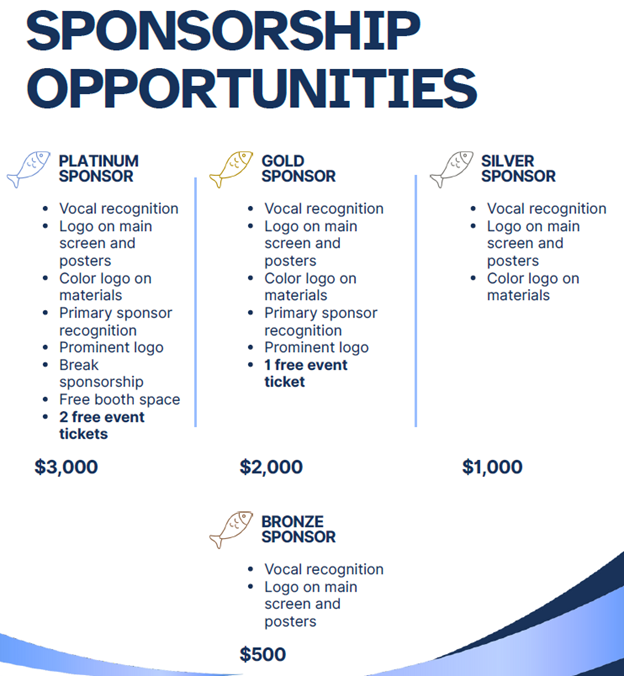
For more information about financial sponsorship, exhibitor information, etc please see our Call for Sponsors document.
Exhibitors at Summit
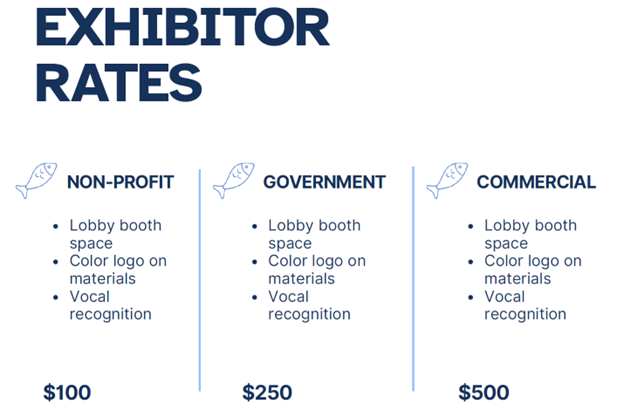
UCSRB is providing opportunities for non-profit, government, and commercial exhibitors at the Science Summit. Click below to register as an exhibitor.
(CANCELED!) 8 km Nordic Race
NOTE: due to poor winter conditions – we decided on January 7th to cancel this Nordic race. Apologies for any inconvenience, and hopefully next science summit we will have adequate snow to hold this race!
New this year is a virtual nordic ski race at the Icicle River Trails, part of the Leavenworth Winter Sports Club trail system. This event will be a “virtual” or QR code race where each racer can race at a time of their choosing and use an app to scan QR codes at the start, middle, and end of their race. The course will be at the Icicle River Trail and the route will be marked. The virtual race will be open from Saturday (January 17th) at 8 am through Wednesday (January 22) 8 am. Two prizes will be awarded during the last day of the summit (Jan 22) at the Festhalle: one prize for the fastest racer and the other prize will be randomly drawn from all race participants. Classic or skate skis are welcome. If you are not a LWSC season pass holder, UCSRB will cover the day pass cost.
Artist
The art for this year’s science summit was created by enrolled member of the Yakama Nation tribe Lorelei Kruger. Her business websites showcases some of her artwork: https://luckyarrowcreations.threadless.com/
Contact
If you have any additional questions or comments, please reach out to Ryan Niemeyer at [email protected].